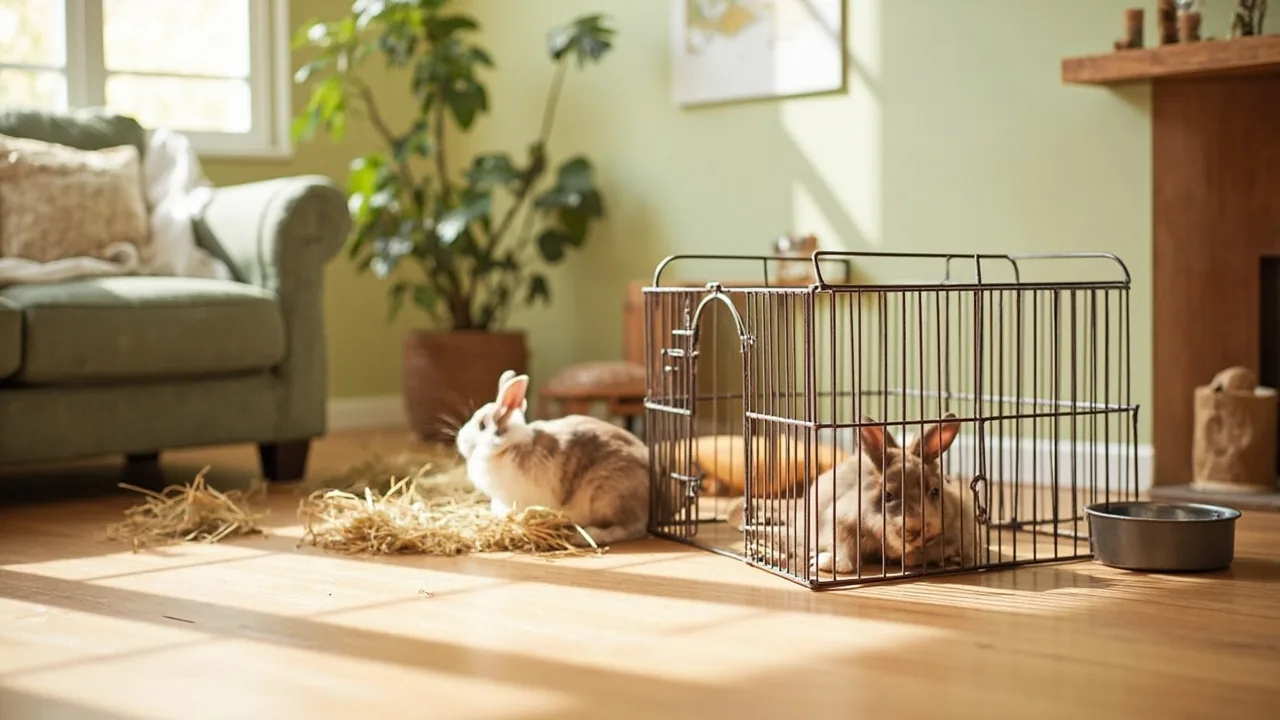
One of the most common mistakes I see new rabbit owners make is buying a cage that is too small. Store-bought rabbit cages are designed for how rabbits look on a shelf, not for how rabbits actually live. The result is a rabbit who cannot fully stretch, hop, or binky in their own space.
An exercise pen solves this problem affordably and flexibly. Unlike a permanent cage, an exercise pen gives you room to create a proper living space without committing to a single location. This guide covers the three main types, what size you actually need, and how to set one up right.
1. Exercise Pen Types Compared
Metal Dog Exercise Pens (X-Pens)
Metal dog exercise pens are the most popular choice for rabbit owners, and for good reason. They are durable, adjustable, and provide good visibility for both you and your rabbit.
X-pens fold flat for storage, connect with metal snap clips, and come in a range of sizes. They are heavy enough to stay in place without being bolted down, but light enough to reposition when needed.
Best for: Most rabbit owners. X-pens offer the best balance of cost, durability, and flexibility.
Considerations:
- Some rabbits lean on or push against the grid bars. X-pens are sturdy enough to handle this.
- The grid spacing on standard dog X-pens is usually 2 inches. For young rabbits or small breeds, you may need to add a layer of hardware cloth to prevent escape or injury.
- Not all X-pens are created equal — cheaper models can have sharp edges. Inspect before use.
NIC Cube Grid Pens
NIC cube grids are modular plastic connectors with wire panels — the kind used for cat furniture and storage cubes. They are lightweight, affordable, and configurable into almost any shape.
Best for: Small spaces, temporary setups, and owners who want maximum configurability.
Considerations:
- NIC grids are not as sturdy as metal X-pens. Determined or large rabbits can push through them.
- The plastic connectors can break over time with heavy use.
- The 1-inch cube size is too small for most adult rabbits to get their heads through safely, but large enough to pose a toe-catching hazard.
- Best used for small or medium rabbits in spaces where an X-pen will not fit.
Custom Enclosure Panels
Some companies sell purpose-built small animal enclosure panels, typically made from powder-coated metal with smaller bar spacing than standard dog pens. These are the most rabbit-specific option but also the most expensive.
Best for: Owners who want a permanent setup and are willing to invest more upfront.
Considerations:
- Higher cost per square foot than dog X-pens.
- Typically more durable long-term.
- Bar spacing is designed for rabbits — typically 1 inch or less.
2. Size Requirements — More Is Always Better
Here is a number I want you to remember: 32 square feet. That is the minimum recommended exercise space for one rabbit, and it is not a number I invented. It comes from decades of rabbit rescue guidance and veterinary consensus.
To put that in concrete terms: a 4-foot by 8-foot pen (32 sq ft) is the bare minimum. For reference, that is about the size of a small bedroom.
If you can go larger, go larger. There is no downside to giving your rabbit more room, and the behavior benefits are significant. Rabbits in larger spaces are more active, more confident, and less prone to the destructive behaviors that come from boredom and frustration.
Minimum Pen Sizes by Number of Rabbits
| Number of Rabbits | Minimum Floor Space |
|---|---|
| 1 rabbit | 32 sq ft (4×8 ft) |
| 2 bonded rabbits | 48 sq ft (6×8 ft) |
| 3+ rabbits | 64+ sq ft |
Calculating What Fits in Your Space
Before you buy anything, measure your available space. Standard X-pen panels are 24 inches wide. A common configuration is:
- 4 panels wide × 4 panels long = 8 ft × 8 ft = 64 sq ft — excellent for one or two rabbits
- 4 panels wide × 2 panels long = 8 ft × 4 ft = 32 sq ft — minimum for one rabbit
- 3 panels wide × 2 panels long = 6 ft × 4 ft = 24 sq ft — too small for a permanent setup
You can configure panels in almost any shape. L-shaped pens, U-shaped pens, and other configurations work well in different room layouts. The important thing is the total floor area, not the specific shape.
3. Height Requirements
Rabbits can jump. A healthy adult rabbit can clear 2 feet easily, and some can manage 3 feet or more when motivated. This means your pen needs to be tall enough that your rabbit cannot vault over the walls.
Minimum height: 36 inches (3 feet) for most adult rabbits.
Some owners use 24-inch pen walls and add a lid or cover to prevent escape. This works but can be inconvenient, especially if you need to reach in to interact with your rabbit.
For dwarf breeds or small rabbits, a 24-inch wall may be sufficient. For large breeds (Flemish Giants, French Lops), you may need 42-inch walls or higher.
If your rabbit is a known jumper or escape artist, get the tallest pen you can find or plan to use a lid. An escaped rabbit in an un bunny-proofed room is a serious situation.
4. Flooring Options
Exercise pens do not have floors. You need to provide one. This is not optional — wire flooring in exercise pens causes bumblefoot, a painful foot infection that can be difficult to treat.
Options for Pen Flooring
Bathroom mats or anti-fatigue mats — Inexpensive and effective. The textured rubber surface provides traction and is easy to clean. You can cut these to fit your pen shape.
Fleece blankets or towels — Soft and comfortable. Change and wash every few days. Some rabbits like to dig at fleece, which is fine unless they are ingesting it.
Vinyl or linoleum tiles — Durable, waterproof, and easy to clean. Available at hardware stores in a range of colors. Can be cut to fit.
Cotton rugs — Machine washable and comfortable for rabbits. Good for larger pens where you can swap out and launder them regularly.
What to Avoid
- Bare wire flooring — Causes bumblefoot
- Slippery surfaces like bare hardwood — Rabbits need traction to run and play safely
- Thin plastic sheeting — Can be chewed and ingested
5. Setup Tips
Place the Pen on a Hard Surface
Exercise pens on carpet are more stable, but they also make it harder to clean underneath. Exercise pens on tile or hardwood are easier to sweep and mop underneath but can slide. A mat under the entire pen helps with both.
Bunny-Proof the Perimeter
Your rabbit will try to reach the outside world. They will also try to chew the pen itself. Keep cords, plants, and other hazards at least 18 inches away from the pen walls. Consider adding bitter-tasting bunny-proofing spray to the pen frame if your rabbit is a chewer.
Give Them a House Inside the Pen
Even in a large pen, rabbits feel exposed without a hiding spot. Place a wooden hideaway house, a cardboard castle, or a tunnel system inside the pen so your rabbit has somewhere private to retreat.
Hay and Litter Box Placement
Place the litter box in one corner of the pen and the hay in or near it. Rabbits eat while they use the bathroom, so putting these together encourages good litter habits and keeps hay consumption high.
Keep Water Accessible
A heavy ceramic water bowl or a stable water bottle mounted on the pen wall ensures your rabbit has access to water at all times without the bowl tipping over.
Pen Location Matters
Rabbits are social and want to be near their people. Place the pen in a room where your family spends time, not in an isolated corner. A pen in a spare bedroom where no one goes will result in a lonely, bored rabbit.
6. Our Top Picks
Best All-Around: MidWest iCourage Extra Large Metal Dog Pen
View on Amazon: MidWest iCourage Dog Pen
24-panel fold-and-go design. 38 inches tall — tall enough for most rabbits. Durable metal construction with rounded edges. Configures to multiple sizes. This is the pen I recommend most often for new rabbit owners setting up their first proper enclosure.
Best for Small Spaces: Amazon Basics Foldable Metal Dog Exercise Pen
View on Amazon: Amazon Basics Dog Pen
More affordable than the MidWest option. 34 inches tall. Same fold-flat design. Works well in apartments or smaller rooms where space is at a premium.
Best for Hardwood Floors: Non-Slip Bathroom Mat
View on Amazon: Non-Slip Bathroom Mat
The rubber-textured surface provides excellent traction for rabbits and prevents the pen from sliding on smooth floors. Cut to fit your pen shape.
Best Enclosure Upgrade: Ferret Nation Habitat
View on Amazon: Ferret Nation Habitat
Not technically an exercise pen, but if you want a permanent multi-level enclosure for a rabbit or bonded pair, the Ferret Nation is the best pre-built option available. Powder-coated metal bars, multiple levels accessible via ramps, and easy-to-clean trays.
The Short Version
Get the largest metal X-pen you can fit and afford. Aim for at least 32 square feet of floor space. Choose walls at least 36 inches tall. Provide soft flooring — a rubber mat or fleece — never bare wire. Place the pen where your rabbit can see you, add a hideaway, and keep hay and water accessible.
An exercise pen is not a cage. It is a rabbit-proofed space that gives your rabbit room to live properly.
⚠️ Medical information: This article is for general educational purposes and is not a substitute for professional veterinary care. Always consult a rabbit-savvy veterinarian for health concerns. See our full disclaimer.