⚠️ Medical information: This article is for general educational purposes and is not a substitute for professional veterinary care. Always consult a rabbit-savvy veterinarian for health concerns. See our full disclaimer.
Quick Answer: GI stasis is a life-threatening slowdown or complete stop of a rabbit's digestive system — it can kill within 24 hours. If your rabbit stops eating, produces no droppings, or has a hard, bloated belly, seek emergency vet care immediately. Do not wait. Early intervention with IV fluids, pain medication, and gut motility drugs gives your rabbit the best chance of recovery.
Bunny 911: When Your Rabbit’s Gut Stops Moving
Your rabbit is lying in the corner, hunched up, not eating. Their belly feels tight. You have a bad feeling in your gut.
GI stasis. The word that makes rabbit owners lose sleep.
Here is the hard truth: GI stasis can kill within 24 hours. But here is also what experienced rabbit owners know — with fast action and the right care, many rabbits make full recoveries. This guide will walk you through exactly what to do, how to make the call between waiting and rushing, what the vet will do, what recovery looks like, and the harder questions too.
The Bunny 911 Decision Tree
Before you panic, answer these questions:
1. Is your rabbit eating anything at all?
- YES: Some hope. Try the home steps below.
- NO: Move to question 2.
2. Is your rabbit producing dropplets (feces)?
- YES, and they look normal (round, dry, dark): Mild slowdown. Monitor closely.
- YES, but small, dry, or strung together: Warning sign. Start home care now.
- NO, or only tiny misshapen ones: Serious. Call the vet.
3. Does your rabbit’s belly feel hard, tight, or bloated?
- YES: This is an emergency. Call now.
- NO, but your rabbit seems uncomfortable: Still call the vet.
4. Is your rabbit grinding teeth, lethargic, or sitting in a meatball posture (hunched with eyes half-closed)?
- YES: Call the vet. This is pain.
- NO, but off food: Start home care and monitor.
Rush to the Vet NOW If:
- Complete refusal to eat for more than 6 hours
- No dropplets for 12+ hours
- Bloated, rock-hard belly
- Severe lethargy — not moving or responding
- Signs of pain (teeth grinding, hunching) combined with no eating
- Watery diarrhea or any blood
These symptoms mean your rabbit needs professional help within hours, not days.
When You Can Wait and Watch (A Few Hours)
If your rabbit is:
- Still eating something, even if less than usual
- Still producing small dropplets
- Bright-eyed and alert
- Belly is soft (not hard or distended)
You can try home support measures (see below) for 4-6 hours, but only if your rabbit is not deteriorating. If anything worsens, call the vet.
After-Hours Emergency Protocol: 2AM and No Vet Available
You are at 2am. Your rabbit is showing warning signs. Your regular vet is closed. Here is what to do:
Step 1: Find an Emergency Vet
- Search: “24 hour exotic animal emergency vet [your city]”
- Call anyway — even if it says “closed,” leave a voicemail. Some have on-call services.
- Use the Association of Exotic Mammal Veterinarians directory (aemv.org) to find specialists.
- If there is a university veterinary hospital near you, they often have 24-hour care.
Step 2: While You Find a Vet — Start Support Care
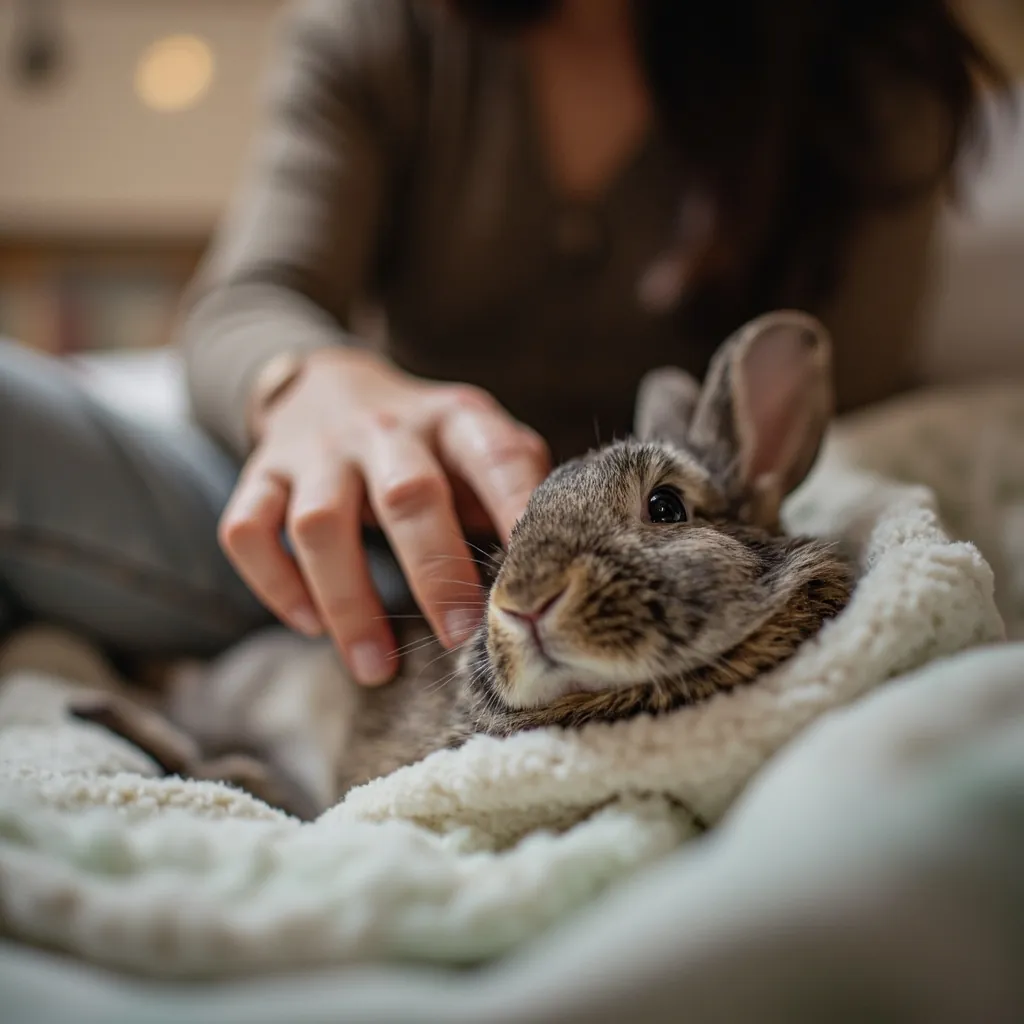
Keep your rabbit warm. GI stasis often causes hypothermia as the gut shuts down and the body loses heat. Wrap your rabbit in a towel and hold them against your body. Target temperature: 100-102°F (38-39°C). You can fill a water bottle with warm (not hot) water and place it under a towel next to your rabbit.
Encourage movement. Gentle walking can stimulate gut motility. If your rabbit can move, let them hop around a small area.
Offer tempting foods. Fresh cilantro, parsley, basil — strong-smelling herbs can sometimes spark appetite. Warm the food slightly (room temperature, not hot) to enhance aroma.
Syringe feed critical care. If you have critical care powder (Oxbow Critical Care or similar — I keep two bags in my emergency kit at all times) on hand, mix with water per package instructions and syringe feed 10-20ml every 2 hours. This does not replace vet care, but it provides nutrition and moisture to keep the gut moving.
Step 3: Do Not
- Do not force feed solid food if your rabbit cannot swallow.
- Do not give any medications without vet guidance — some human or dog meds are toxic to rabbits.
- Do not put your rabbit in water or attempt to “soak” them.
- Do not wait until morning if you have the symptoms listed under “Rush to the Vet NOW.”
What the Vet Actually Does
You get to the clinic. Your rabbit is admitted. What happens next?
Understanding the process helps you make decisions and communicate clearly.
Examination (15-30 minutes)
The vet will:
- Palpate your rabbit’s belly — feeling for gas buildup, blockages, pain response
- Check temperature — rabbits with GI stasis are often hypothermic
- Listen to gut sounds with a stethoscope — a healthy gut should make soft gurgling sounds; silence or excessive gas sounds indicate problems
- Check hydration by skin turgor (pinching the skin — it should snap back quickly)
- Examine teeth and eyes as part of overall assessment
Initial Treatment
Pain management: Rabbits with GI stasis are in significant pain. The vet will typically give meloxicam (a rabbit-safe NSAID) or sometimes buprenorphine. Do not skip this — pain causes stress, which worsens the condition.
Gut motility agents: Medications like metoclopramide (Reglan) or cisapride help stimulate the digestive tract to start moving again. These are often given by injection first for faster effect.
Fluid therapy: Your rabbit is likely dehydrated, which makes everything worse. The vet will give subcutaneous (under the skin) or intravenous fluids. IV is faster and more effective for severe cases.
Syringe feeding: The vet or technician will begin critical care formula via syringe. This provides nutrition and stimulates gut activity.
Diagnostic Tests (Optional, Based on Severity)
The vet may recommend:
- X-rays ($150-300): To see gas patterns, blockages, organ position. X-rays are the single most useful diagnostic tool for GI stasis.
- Blood work ($100-250): To check liver and kidney function, electrolyte imbalances.
- Ultrasound ($250-400): For a more detailed look at organs and gut wall thickness.
These tests help rule out obstructions or other conditions that would change treatment. If your rabbit is critical, the vet may start treatment before testing to save time.
Hospitalization vs. Outpatient
For mild cases, the vet may send you home with medication and critical care after a few hours of treatment. For moderate to severe cases, your rabbit may stay overnight or longer for IV fluids, continuous monitoring, and round-the-clock syringe feeding.
Expect costs of $300-800 for emergency treatment without hospitalization, $800-2000+ for an overnight stay with IV fluids and monitoring.
Recovery Timeline: Day by Day
Every rabbit is different, but here is what a typical recovery looks like:
Day 1 (Treatment Day)
- Vet visit, medications, fluids, syringe feeding started
- Your rabbit may be very groggy from pain meds
- Keep warm, quiet, in a dark space if possible
- Offer hay and favorite foods, but do not force
- Dropplet production may be minimal
Day 2-3
- Dropplets should start returning — small at first, then normalizing
- Appetite should improve as pain reduces and gut starts moving
- You will be syringe feeding critical care 3-4 times daily at home
- Your rabbit may seem more alert
- If no improvement by day 3, follow up with your vet — something else may be wrong
Day 4-7
- Most rabbits are eating independently again by day 4-5 with proper care
- Dropplets should be back to normal (round, dry, plentiful)
- Medication doses may decrease per vet instruction
- Your rabbit should be alert, active, interested in food
- Some rabbits need 2 weeks to fully recover
Week 2 and Beyond
- Your rabbit is eating normally, dropplets are consistent
- Address the underlying cause: dental exam, diet review, stress reduction
- Follow up with your vet to confirm recovery and any next steps
- This is the time to fix what caused the episode so it does not happen again
Red flag: If your rabbit improves then crashes again, or shows cyclical improvement/decline over 48 hours, something more serious may be going on — a partial blockage, liver lobe torsion, or other complication. Return to the vet immediately.
Real Stories: Owners Who Have Been There
“I woke up at 3am and noticed Clover had not touched her morning salad. By 5am she was huddled in the corner. I called the emergency vet at 5:30am and we were there by 7. She spent 3 days in the hospital on IV fluids. The bill was $1,400. I almost waited until morning. I almost did not go. I am so glad I did.” — Megan R., rabbit owner since 2019
“My vet taught me to check dropplets every morning. It sounds weird, but it saved my rabbit’s life twice. The first time, I noticed the dropplets were half the normal size and connected by stringy mucus. I caught it early both times and avoided the emergency vet. Early detection is everything.” — Tom L., longtime rabbit dad
“We had to make a choice with our elderly rabbit Fritz. The vet said he could try surgery but the odds were not good and recovery would be brutal. We chose comfort care. We kept him warm, gave him pain meds, hand-fed him, and he lived another 6 weeks that way — happy, in his favorite spot, with us beside him. That was the right choice for us.” — Sarah K.
When to Consider Euthanasia: The Hard Conversation
No one wants to talk about this, but rabbit owners need to know when the kindest choice is letting go.
Consider euthanasia if:
- Your rabbit has a complete obstruction that requires surgery, and you cannot afford or do not want to risk surgery (obstruction surgery in rabbits has high mortality)
- Your rabbit has liver lobe torsion — a common complication of GI stasis that requires emergency surgery, expensive and often fatal even with treatment
- Your rabbit has been in severe pain for more than 24-48 hours with no improvement
- Quality of life has declined significantly — not eating, not moving, no interest in surroundings even with treatment
- Your rabbit has multiple chronic conditions that keep causing GI stasis episodes and he or she is suffering
This is not failure. Choosing to prevent suffering is one of the hardest and most loving things an owner can do. Your vet can walk you through what to expect, and many offer at-home euthanasia for rabbits who are more comfortable in familiar surroundings.
Prevention: The Diet Foundation
GI stasis is largely preventable. Here is what every rabbit needs:
Unlimited timothy hay (or meadow hay, oat hay, botanical hay — variety is fine) Hay should make up 80% of your rabbit’s diet. It provides the fiber that keeps the gut moving. A rabbit without constant access to hay is at serious risk.
Moderate vegetables (1-2 cups per day for an average adult rabbit) Leafy greens like romaine, butter lettuce, cilantro, parsley — not icebergs. Introduce new veggies slowly.
Limited pellets (1/4 cup per day maximum) Pellets are convenient but should not be the main food. Choose timothy-based pellets with no added seeds, nuts, or colored pieces.
Fresh water always available Change water daily. Some rabbits prefer bowls over bottles — experiment.
Stress management GI stasis often starts after a stressful event — moving, new pet, loud construction, loss of a bonded partner. Minimize changes when possible, and monitor eating habits closely after disruptions.
Daily dropplet checks Yes, really. Look at the dropplets every day. Normal: round, dry, dark brown, plentiful. Abnormal: small, dry, strung together, wet, or missing. This 30-second check can catch problems before they become emergencies.
Your Emergency Kit Should Include
I put together a complete emergency kit checklist so you know exactly what to have on hand — and what to replace before it expires. Download it free below.
Also, get your emergency supplies from Amazon — Critical Care powder, syringes, and heating pads can all be delivered quickly when you need them most.
- Critical Care powder (Oxbow Critical Care)
- 10-20ml syringes (no needle) — get on Amazon
- Digital thermometer
- Heating pad or heating pad from Amazon (keep one in your emergency kit)
- Your exotic vet’s phone number (written down, not just in your phone)
- 24-hour emergency vet contact
- Rabbit-safe pain medication (meloxicam) — ask your vet for a prescription to keep on hand
- Small blanket or towel for transport
📋 Download our full Rabbit Emergency Kit Checklist with a printable checklist you can keep on your fridge.
The Bottom Line
GI stasis is terrifying. Every rabbit owner who has been through it remembers the fear — the feeling of not knowing if your rabbit will make it through the night.
Here is what matters most:
Act fast. Do not wait. If your rabbit is not eating, not dropping, and showing signs of distress — call the vet. A few hours can make the difference between a full recovery and something much worse.
Know the signs. Educate yourself before an emergency happens. Read our guide to signs your rabbit is sick so you can catch problems early.
Have a vet. Find an exotic animal vet before you need one. Rabbits who see exotic specialists have better outcomes. Not all vets treat rabbits — find one who does.
Trust yourself. If something feels wrong, it probably is. You know your rabbit better than anyone. When in doubt, call.
Your rabbit’s life may depend on your quick action. And that is something worth being ready for.
Be Prepared Before a Crisis Happens
Download our free Rabbit Emergency Kit Checklist to make sure you have everything you need.
Shop rabbit health supplies on Amazon →
When to Seek Professional Help
While home care can manage many situations, some circumstances require immediate professional veterinary attention. Understanding the difference between what you can handle yourself and what needs a veterinarian is one of the most important skills a rabbit owner can develop.
Contact a rabbit-savvy veterinarian immediately if:
- Your rabbit has stopped eating or drinking entirely
- You notice difficulty breathing or persistent wheezing
- There is visible injury, bleeding, or open wounds
- Your rabbit is unresponsive, severely lethargic, or unable to stand
- You suspect poisoning from a toxic plant or substance
- There has been no fecal output for more than 12 hours
Keep your veterinarian’s contact information and the number of the nearest after-hours emergency rabbit clinic posted somewhere easy to find. A rabbit emergency at 10pm is a terrible time to be searching for a phone number.
Long-Term Management and Prevention
Many rabbit health and behavior issues can be prevented or minimized with consistent daily care. A stable routine, appropriate diet, clean housing, and regular veterinary checkups form the foundation of preventive care. Monitor your rabbit daily for subtle changes — a slightly reduced appetite one day might be nothing, or it might be the first sign of a developing problem.
Keep a log of your rabbit’s normal behavior, droppings, eating patterns, and energy levels. When you know what normal looks like, you will notice deviations much faster. Early detection of problems almost always means simpler, cheaper treatment and better outcomes.
Building a Rabbit-Savvy Care Routine
The best rabbit care is routine-driven and consistent. Feed at the same times each day, clean the enclosure on a regular schedule, and provide fresh water daily. Handle your rabbit gently and consistently to build trust. Spay or neuter to prevent reproductive cancers and reduce problem behaviors. Keep your rabbit’s environment stable — rabbits thrive on predictability.
Invest in quality hay, appropriate housing, and the best veterinary care you can afford. The upfront cost of proper setup and preventive care is far less than treating a preventable illness or emergency.